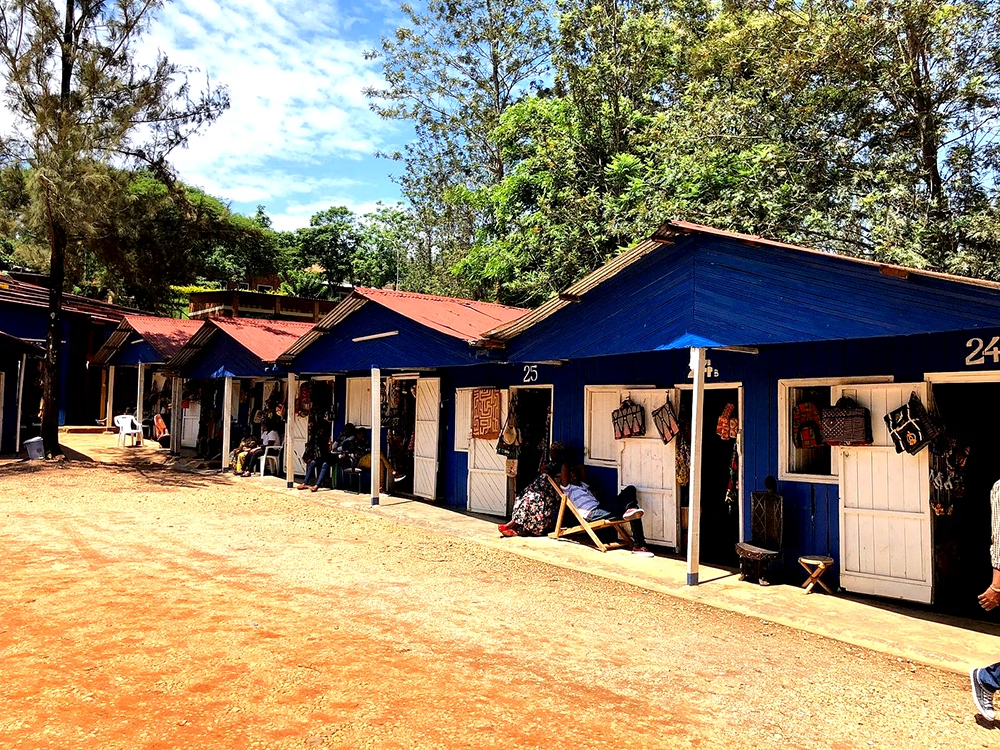
Caplaki Craft Village Kigali 2026: The Complete Guide to Rwanda’s Best Artisan Market
If there is one place in Kigali where Rwanda’s creative identity comes fully alive in a single afternoon, it is Caplaki Craft Village. Tucked into the Kiyovu neighborhood, this cooperative artisan market has become one of the city’s most beloved cultural destinations — a place where dozens of independent artists sell handmade work that carries the weight of tradition, the precision of craft, and the warmth of personal story. Whether you’re searching for the perfect Rwandan souvenir, looking to understand the country’s artistic heritage more deeply, or simply wanting to spend an hour in an environment that feels genuinely alive, Caplaki delivers. This guide tells you everything you need to know before you go.
What Is Caplaki Craft Village?
Caplaki Craft Village is a cooperative artisan market established to give Kigali’s independent craftspeople a permanent, organized space to sell their work directly to buyers. Unlike souvenir shops in airport departure halls or hotel lobbies — where goods are often mass-produced and the maker is invisible — Caplaki is structured around direct artist-to-buyer transactions. The person selling you a basket almost certainly made it. The painter whose work you’re considering can likely tell you exactly what inspired it.
The market occupies a compound of wooden stalls in Kiyovu, arranged in a layout that encourages browsing and discovery. Each stall is independently operated, meaning the range, style, and personality of what’s on offer varies considerably from one seller to the next. Part of the pleasure of visiting Caplaki is that slow, exploratory movement from stall to stall — finding unexpected work, starting conversations, and letting the quality and character of each piece reveal itself gradually.
The market has grown significantly in reputation over the past decade and now attracts both international tourists looking for authentic souvenirs and Kigali residents seeking quality handmade gifts. It is consistently rated among the top cultural experiences in Kigali on travel platforms — and consistently delivers on that reputation.


Why Caplaki Matters: Culture, Community & Ethical Tourism
It would be easy to describe Caplaki simply as a shopping destination — and it is an excellent one. But that description undersells what the market actually represents and why a visit here carries a weight that browsing a souvenir shop cannot match.
Keeping Traditional Crafts Alive
Many of the crafts sold at Caplaki are rooted in techniques and traditions that stretch back generations. Agaseke basket weaving — Rwanda’s most celebrated craft tradition — requires skills passed from mother to daughter over years of practice. Imigongo geometric painting uses materials and methods developed centuries ago. Wood carving traditions connect contemporary Kigali artists to an ancestral visual language that predates colonial influence entirely. When these crafts are made and sold, the knowledge that produced them remains living rather than archived.
Empowering Independent Artisans
Caplaki operates as a cooperative framework, giving independent artists — many of them women — a physical platform and a reliable income stream that would otherwise be difficult to establish alone. Rwanda’s craft economy is significant: the work done here supports families, funds children’s education, and contributes to the dignified economic independence of people who have chosen art as their livelihood. Every purchase at Caplaki is a direct, traceable investment in that system.
A More Honest Form of Tourism
Tourism that channels money to local makers rather than to import/export middlemen is better for the communities that host it. Caplaki makes this possible in a way that is easy and enjoyable for visitors: you browse, you find something you love, you buy it from the person who made it. The economic logic is straightforward; the human connection that comes with it is genuinely valuable.
Agaseke Peace Baskets
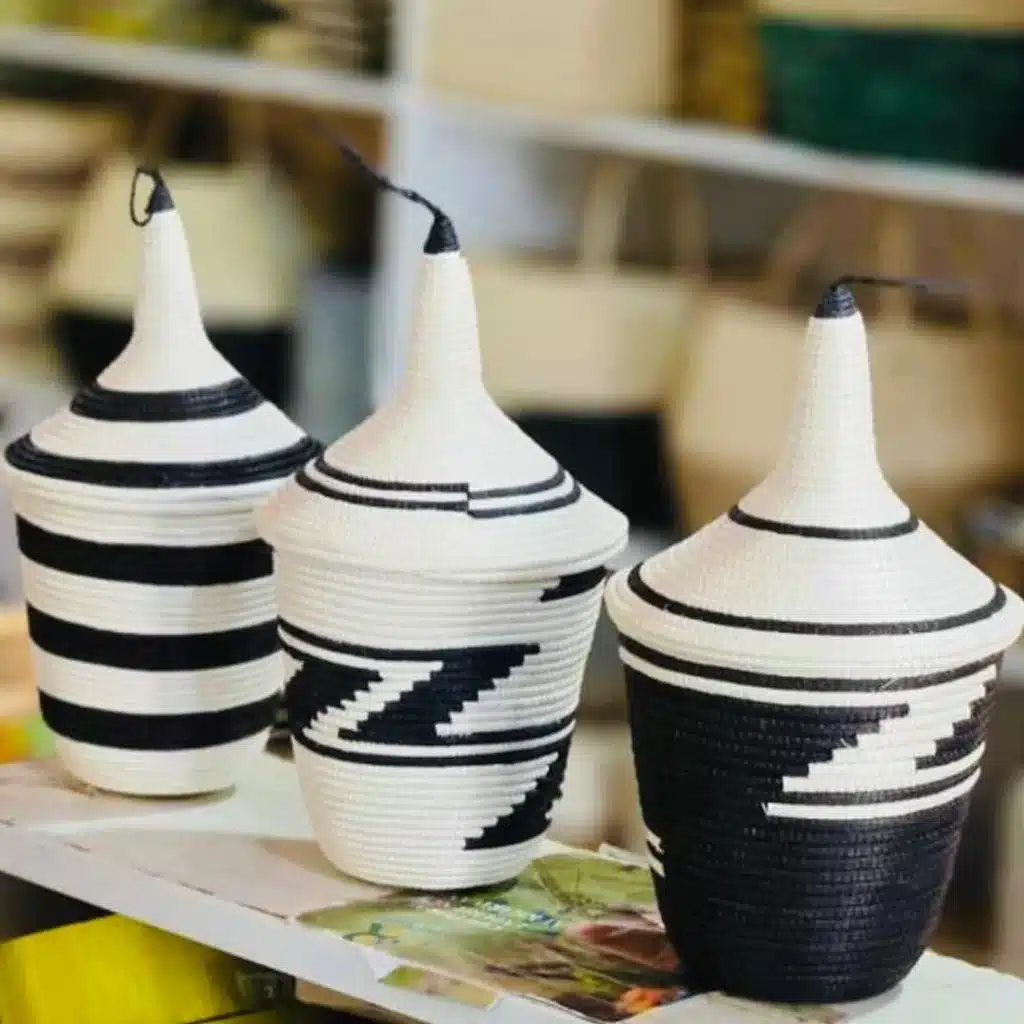
The agaseke is Rwanda’s most recognized traditional craft — a tightly woven lidded basket made from sweetgrass and sisal, decorated with geometric patterns in natural dyes. Originally used in Rwandan royal ceremonies and presented as gifts at weddings and other important occasions, the agaseke carries deep cultural symbolism: the lid represents shelter and protection; the geometric patterns encode meaning specific to the maker’s community and tradition.
Today, agaseke baskets are woven primarily by women’s cooperatives across Rwanda, and the craft has been recognized internationally as a symbol of post-conflict reconciliation and female economic empowerment. You will find agaseke at Caplaki in a remarkable range of sizes and styles — from tiny decorative pieces small enough to sit on a mantlepiece, to large functional baskets designed to be used daily, to contemporary interpretations that adapt the traditional form with modern colors and patterns.
Quality varies significantly between makers. The hallmarks of a well-made agaseke are tight, even weaving with no gaps or loose strands, a lid that sits perfectly flush, clean pattern execution with crisp edges between colors, and a base that sits flat without tilting. Take your time examining the stitching closely — a high-quality agaseke is a lifetime object; a poorly made one will unravel within months.
Imigongo Geometric Art
Imigongo is one of the most distinctive and visually striking art forms in all of Africa — and it is unique to Rwanda. Traditionally made from cow dung mixed with ash and sculpted into raised geometric patterns on wooden or bark panels, then painted in bold blacks, whites, reds, and earth tones, imigongo has been practiced in the eastern province of Rwanda for centuries. It is recognized as an intangible cultural heritage of Rwanda and increasingly celebrated in international contemporary art circles.
The geometric patterns in imigongo are not merely decorative. They encode meaning — specific symbols represent concepts like abundance, protection, power, and community — in a visual language that predates written communication in the region. Different patterns are associated with different clans and regions, making each panel a readable document as well as a beautiful object.
At Caplaki, you will find imigongo panels ranging from small, framed pieces ideal for carrying home in a suitcase, to large statement works that function as serious wall art. Contemporary Rwandan artists have expanded the tradition to include new colors, larger formats, and abstract interpretations — but the best work remains rooted in the original raised-surface technique that gives imigongo its tactile, almost sculptural quality.
Hand-Painted Artwork & Prints
Caplaki’s painted artwork spans a broad spectrum — from small, affordable prints that can be rolled and carried home in a tube, to original canvases and wooden panel paintings that represent serious artistic output. The subject matter is equally wide: wildlife scenes (particularly gorillas, elephants, and East African birds), Rwandan village life, figurative portraits, abstract work rooted in traditional color palettes, and contemporary urban scenes depicting Kigali’s rapid transformation.
Some of Caplaki’s painters are self-taught artists who developed their practice through years of market selling; others are formally trained graduates of Rwandan art programs who use the market to reach an international audience without a gallery intermediary. The quality variation is significant — which means both that great work is available at very reasonable prices, and that some of what’s on offer is better skipped. Take your time moving between the painting stalls, look carefully at the finish quality, and trust your instinct about which pieces carry genuine artistic intention behind them.
Many sellers will allow you to commission custom work — a portrait, a specific scene, or a piece in a particular style or size. If you see a painter whose work you love but whose existing pieces don’t quite match what you need, ask. Several Caplaki artists have an established practice of taking commissions from international buyers and shipping finished work internationally.
Wooden Sculptures & Masks
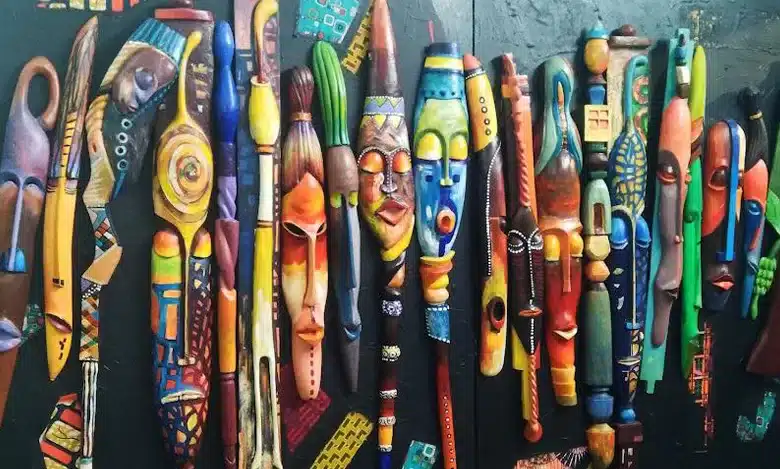
Wood carving is one of Rwanda’s oldest artistic traditions, and Caplaki’s carvers represent some of the most skilled practitioners currently working in Kigali. The range of carved work on offer spans traditional masks and ancestral figures to contemporary animal sculptures, decorative bowls, and abstract forms that interpret traditional motifs in modern shapes.
Rwandan wooden masks have their own distinct visual language — different from West African mask traditions that many visitors may be more familiar with. Look for the precise geometric patterning, the stylized facial features, and the use of natural pigments that characterize authentic Rwandan carving. The quality of the wood itself matters: pieces carved from hardwood (mahogany, ebony, or local hardwoods) will be denser, smoother, and more durable than those from softer wood. A quality carved piece has no visible tool marks on finished surfaces and maintains clean, consistent lines in its geometric elements.
Animal sculptures — particularly gorillas, which hold enormous symbolic significance in Rwanda’s post-conservation identity — are among the most popular purchases. A well-carved gorilla sculpture in dark hardwood makes one of the most distinctive Rwandan gifts available anywhere in the country.
Beaded Jewelry & Accessories
Beadwork has been central to Rwandan ceremonial dress and personal adornment for centuries, and Caplaki’s jewelry makers work in a tradition that connects contemporary fashion sensibility to those deep roots. The pieces on offer range from traditional designs using natural materials — seeds, bone, and recycled glass — to more contemporary jewelry incorporating semi-precious stones, recycled paper beads, and mixed materials.
Recycled paper bead jewelry has become one of Rwanda’s most celebrated contemporary craft forms. Strips of magazine and newspaper pages are tightly rolled into smooth, lacquered beads, then strung into necklaces, bracelets, and earrings that are colorful, lightweight, and entirely unique. Several Kigali women’s cooperatives have built international export businesses on the strength of this product — and you can buy directly from the makers at Caplaki at a fraction of what the same pieces cost in design shops in London or New York.
Beyond paper beads, look for intricate seed bead pieces in traditional Rwandan patterns, banana fiber accessories, and handmade leather items decorated with beadwork. Jewelry is one of the easiest categories of Caplaki purchase for international travelers: pieces are lightweight, pack easily, make excellent gifts, and span an enormous price range from a few dollars to more significant investment pieces.
Kitenge Fabrics & Textile Crafts
Kitenge — a brightly colored, wax-resist dyed cotton fabric used throughout East and Central Africa — is one of the most visually striking materials at Caplaki. Available by the meter or made up into finished items including bags, cushion covers, table runners, clothing, and accessories, kitenge brings the vivid color palettes and bold geometric patterns that have defined East African textile culture into an easily portable and genuinely useful format.
Rwanda’s kitenge production incorporates both pan-African pattern traditions and distinctly Rwandan motifs — look for designs featuring the peace basket pattern, the Rwandan national symbols, and color combinations specific to different regions. Several Caplaki sellers carry fabrics made by local textile cooperatives that support rural women’s economic independence through production work.
For travelers who want something genuinely wearable, a few Caplaki tailors can create custom clothing from kitenge fabric within 24–48 hours — dresses, shirts, skirts, and wraps that fit your measurements and incorporate the pattern of your choice. Ask around the fabric stalls for current recommendations on who is doing the best tailoring work.
Traditional Drums & Musical Instruments
Rwanda has a rich musical tradition centered on the ingoma — the traditional drum — and the inanga, a traditional string instrument resembling a trough zither. Both are available at Caplaki in forms that range from fully functional instruments to smaller decorative versions designed for display. The ingoma in particular holds enormous cultural significance: royal drummers (abatimbo) were among the most honored members of the Rwandan royal court, and the rhythms they played had specific ceremonial functions that are still preserved and performed today.
Decorative drums at Caplaki are typically hand-carved from a single piece of wood and covered with animal skin, then decorated with geometric patterns and sometimes beadwork. They are beautiful objects that function well as statement home décor even if you never intend to play them. Fully playable drums are also available at several stalls — and the sellers are often happy to give a brief demonstration of traditional rhythms.
Smaller instruments — traditional flutes, shakers made from gourds, and small percussion instruments — are available at low prices and are among the most packable cultural purchases at Caplaki. They make excellent gifts for children and music lovers alike, and carry the added value of being genuinely handmade objects with cultural context behind them.
How to Buy Smart: A Bargaining Guide
Bargaining is a normal and expected part of the Caplaki experience. Most sellers price their goods with negotiation in mind, and a respectful exchange about price is part of the social fabric of the market. However, there are ways to bargain that work well and ways that leave everyone feeling worse.
Bargaining at Caplaki: What Works
- Start by engaging genuinely with the work. Ask the seller about the piece before asking about the price — where it was made, how long it took, what the pattern means. This establishes you as a respectful buyer rather than a haggler, and often results in a more generous price without any negotiation.
- Counter at 60–70% of the asking price as a starting point. This gives space for both parties to meet in the middle. Opening too low (below 50%) can feel disrespectful and often shuts down the negotiation entirely.
- Buy multiple items from one seller. Purchasing two or three pieces from the same stall gives you real leverage for a better price across the lot — more so than trying to negotiate down one item.
- Be willing to walk away — but only if you mean it. If you express genuine intention to leave and the seller doesn’t move, respect that. Don’t use walking away as a manipulation if you’re not prepared to follow through.
- Know a fair price when you reach it. The goal isn’t to pay the minimum possible — it’s to pay a fair price that reflects the quality and skill of the work and leaves the seller able to sustain their practice. Rwanda’s artisans are not wealthy people; the difference between a good price and a rock-bottom price often means a great deal more to them than it does to an international traveler.
- Bring Rwandan Francs (RWF) in cash. Paying in local currency at the correct rate avoids the exchange-rate ambiguity that can complicate USD transactions and is simply more straightforward for everyone.
Planning Your Visit: Hours, Location & Tips
📍 Location
Kiyovu, Kigali — near the city center, close to the Serena Hotel and within easy reach of most Kigali hotels. Ask your hotel reception or a moto-taxi driver for “Caplaki” — it is well known to all Kigali locals.
🕘 Opening Hours
Open daily from 9:00 AM to 6:00 PM, including weekends and public holidays. Individual stalls may close earlier or arrive later — the market is fullest between 10 AM and 4 PM.
💰 Payment
Most stalls accept Rwandan Francs (RWF) cash. Some sellers accept MTN Mobile Money (MoMo). US dollars are sometimes accepted but at unfavorable rates. Withdraw RWF from an ATM before visiting for the smoothest experience.
🚗 Getting There
Easily reachable by car, moto-taxi, or on foot from most Kigali city center hotels. Moto-taxi from the city center takes 5–10 minutes and costs 500–1,000 RWF. Ask to be dropped at “Caplaki Craft Village” or “Caplaki Market.”
⏰ Best Time to Visit
Mid-morning (10 AM – 12 PM) on weekdays is ideal — sellers are present and engaged, the market is busy but not crowded, and you have the best chance of genuine conversations with artisans. Weekends are livelier but also more crowded.
📦 Packing & Shipping
Several sellers can arrange professional packing and international shipping for larger purchases. If you fall in love with a piece that won’t fit in your luggage, ask the seller — many have established shipping contacts and can provide quotes and timelines on the spot.
Best Time to Visit Kigali for Craft Shopping
Caplaki is open year-round and can be visited at any time, but certain times work better than others for different types of visitors.
June – September (Peak Season)
The highest volume of international visitors means more stalls are fully stocked and sellers are most motivated. If you want the widest possible selection — particularly of higher-end commissioned pieces — this is the ideal time. Arrive early in the morning to avoid the biggest tour group rushes.
December – February (Short Dry Season)
Fewer tourists than peak season, but the market is still well stocked. Sellers have more time to talk, bargaining is often slightly more relaxed, and the experience is less rushed. A particularly good time for visitors who want genuine engagement with the artisans rather than a quick browse.
March – May (Long Rains)
Fewer visitors overall — the market is quieter and some sellers may operate reduced hours. The genuine benefit is time: unhurried conversations, patient sellers, and the best opportunity to have pieces explained in depth. Bring an umbrella for afternoon showers walking between stalls.
October – November (Short Rains)
Similar to the long rains — quieter and more personal. Some of the market’s best artisans use slower periods to produce new stock, so you may find fresher, less frequently seen work available. Midmorning visits are best to avoid afternoon showers.
Caplaki vs. Other Kigali Markets
Caplaki is the best-known artisan market in Kigali, but it’s not the only place to buy crafts. Here’s how it compares to the alternatives:
| Market | Location | Best For | Price Level | Authenticity |
|---|---|---|---|---|
| Caplaki Craft Village | Kiyovu | All crafts, direct from makers | Mid-range, negotiable | Very high — maker present |
| Kimironko Market | Kimironko | Fabric, fresh produce, everyday goods | Low — local market prices | Variable — mix of origins |
| Nyamirambo Women’s Center | Nyamirambo | Cooperative-made crafts, textiles | Fixed fair-trade prices | Very high — certified cooperative |
| Hotel gift shops | Citywide | Convenience souvenirs | High — premium location | Variable — often imported |
| Airport duty-free | Kigali Airport | Last-minute purchases | High — captive market pricing | Low — often mass-produced |
Frequently Asked Questions: Caplaki Craft Village Kigali
What is Caplaki Craft Village in Kigali?
Caplaki Craft Village is a cooperative artisan market in Kiyovu, central Kigali, where over 50 independent sellers offer handmade Rwandan crafts including agaseke baskets, imigongo geometric art, wooden sculptures, beaded jewelry, kitenge textile accessories, and traditional drums. It is widely considered the best place in Kigali to buy authentic Rwandan souvenirs directly from the makers.
Where exactly is Caplaki Craft Village located?
Caplaki is located in the Kiyovu neighborhood of Kigali, near the city center and close to the Serena Hotel. It is accessible by moto-taxi (5–10 minutes from central Kigali), private car, or on foot from most central hotels. It is well known to all Kigali taxi and moto-taxi drivers.
Can you bargain at Caplaki Craft Village?
Yes — bargaining is standard practice and expected. Start your offer at around 60–70% of the asking price and negotiate respectfully toward a fair middle ground. Avoid aggressive bargaining; these are independent artisans whose livelihoods depend directly on their sales. Buying multiple items from one seller gives the most room for negotiation.
What are the best things to buy at Caplaki Craft Village?
The standout purchases are agaseke peace baskets (Rwanda’s most iconic craft), imigongo geometric paintings (unique to Rwanda), recycled paper bead jewelry (lightweight, genuinely handmade, excellent value), and wooden gorilla sculptures in hardwood. All make exceptional, authentically Rwandan gifts.
What payment methods does Caplaki accept?
Rwandan Francs (RWF) cash is the primary and most straightforward payment method. Some sellers accept MTN Mobile Money (MoMo). US dollars are sometimes accepted at less favorable rates. Withdraw RWF from an ATM before visiting for the smoothest experience.
Can you ship purchases from Caplaki internationally?
Yes — several sellers at Caplaki have established relationships with local packing and shipping companies and can arrange international delivery for larger or fragile purchases. Ask the seller directly about their shipping options and get a cost and timeline estimate before committing.
Is Caplaki Craft Village free to enter?
Yes. There is no entry fee to visit or browse Caplaki Craft Village. You pay only for what you purchase. Tips to guides, if you use one, are voluntary and at your discretion.
How long should I spend at Caplaki Craft Village?
Allow at least 1.5–2 hours for a thorough visit that includes browsing, conversation with artisans, and making purchases. If you’re planning to commission custom kitenge clothing or discuss larger purchases, allow 2–3 hours. The market rewards slow, curious exploration rather than a quick pass-through.
Is Caplaki suitable for children?
Yes — Caplaki is a relaxed, open-air environment that is entirely suitable for children of all ages. Many children are particularly interested in the drums and musical instruments, and the brightly colored textiles and jewelry. The market atmosphere is friendly and unhurried, making it a comfortable family experience.
Caplaki Craft Village is more than a souvenir market — it is a living archive of Rwandan creative identity, a direct economic lifeline for dozens of independent artists, and one of the most genuine cultural experiences available in Kigali. Come ready to browse slowly, ask questions, and leave with something made by a real person with a real story. That story travels home with you.