Transport in Rwanda 2026: The Complete Guide for Tourists
Rwanda is one of Africa’s most straightforward countries to navigate — roads are well maintained, public transport runs reliably, and you’ll rarely feel lost or unsafe on the road. But transport in Rwanda looks very different depending on whether you’re hopping between Kigali neighbourhoods on a moto, catching an express bus to Gisenyi, or organizing a dawn departure for gorilla trekking. This guide covers every transport option available to tourists in Rwanda: what each costs, when to use it, and exactly how to book — so you can focus on the journey rather than the logistics.
Why Getting Around Rwanda Is Easier Than You Think
Many first-time visitors to Africa arrive in Rwanda braced for the transport chaos they’ve read about or experienced elsewhere on the continent. They are consistently surprised. Rwanda’s road network is, by any regional measure, excellent. The main highways between Kigali and every major destination — Musanze (Volcanoes), Gisenyi (Lake Kivu), Huye, and the national park entrances — are fully paved and well maintained. Traffic in Kigali is lighter than most African capitals. Bus services run to schedule. Road safety, while imperfect, is far better than regional norms.
The country is also extremely compact. Rwanda can be driven end-to-end in under four hours on a good day. Every major tourist destination — Volcanoes National Park, Akagera, Nyungwe, Lake Kivu — is within a half-day’s drive of Kigali. This means that even travelers on tight schedules can reach and enjoy multiple destinations without spending excessive time in transit.
The result is that transport in Rwanda, once you understand the options, becomes straightforward to plan. The key decisions are simply: which option fits your budget, your itinerary, and the level of independence you want.
Kigali City Buses & the Tap&Go System
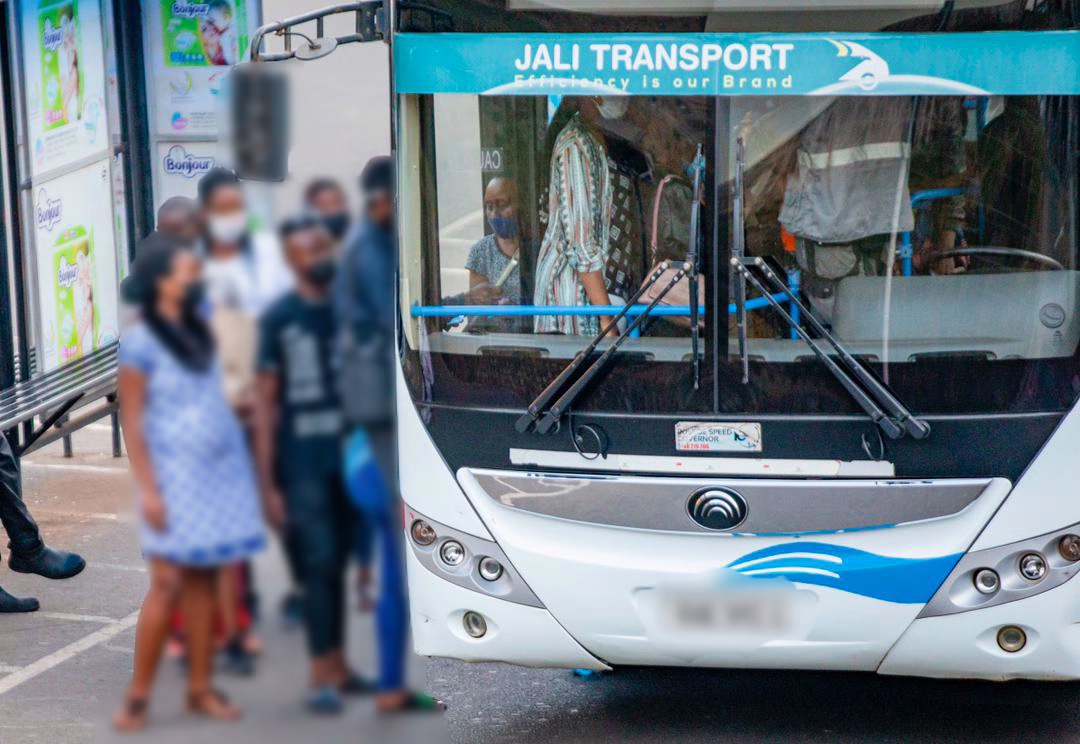
Kigali’s city bus network is one of the best-organized urban bus systems in sub-Saharan Africa. Routes cover all major parts of the city and run from early morning until late evening. The system uses a prepaid card called Tap&Go — a contactless card you tap when boarding and tapping again when exiting, with the fare automatically deducted based on distance traveled.
Tap&Go cards can be purchased and topped up at bus stations, Kigali’s major supermarkets (Nakumatt, Simba), and thousands of small kiosks around the city. The card costs around 1,000 RWF (roughly $0.85) to issue, and individual fares range from 500–1,000 RWF. For tourists staying multiple days in Kigali, the system is genuinely efficient and worth using for non-time-sensitive journeys.
The main limitation for tourists is navigation: bus stop signage in English is limited outside the city center, and routes are not intuitively obvious to first-time visitors. For this reason, city buses are most useful for tourists who are staying in Kigali for several days, are comfortable asking locals for directions, or who have a local contact to advise on routes. For one or two day visits to the city, ride-hailing apps are simpler.
- Cheapest way to move around Kigali
- Clean and well managed
- Good frequency on main routes
- Card reusable throughout your stay
- Limited English signage
- Routes confusing for first-timers
- Kigali only — no intercity service
- Can be crowded at peak hours
Moto Taxis — Rwanda’s Iconic Ride
You cannot spend more than 10 minutes in Rwanda without seeing motos — the motorcycle taxis that are the country’s most visible and democratic form of transport. They are everywhere: lined up at every junction, weaving through Kigali traffic, and parked in clusters outside every market and bus station in every town in the country. Wave one down, state your destination, agree a price (or use an app), climb on, and you’re moving within seconds.
For short urban trips — crossing a Kigali neighbourhood, getting from a bus station to your hotel, reaching a restaurant that isn’t walkable — motos are the fastest, cheapest, and most convenient option available. They thread through traffic that stops cars. They go places buses don’t reach. And the experience of riding through Kigali’s hills on the back of a motorcycle, watching the city slide past, is genuinely one of those travel moments that people talk about for years.
Rwanda requires all moto passengers to wear helmets — drivers carry a spare for their passenger. This rule is enforced, and the helmets are visible (if not always spotless). For booking with guaranteed vetted drivers and upfront pricing, use the Yego Moto or Move apps rather than hailing from the street. App-based rides are marginally more expensive but eliminate the need to negotiate fares.
- Fastest for short distances
- Available everywhere, no waiting
- Very affordable for the distance
- App options eliminate fare negotiation
- Not suitable for long distances
- Uncomfortable in heavy rain
- Single passenger only (no luggage)
- Street hailing requires fare negotiation
Car Taxis & Ride-Hailing Apps
For car-based travel within Kigali — airport transfers, hotel-to-restaurant journeys, or any trip where a moto isn’t practical (luggage, formal attire, accompanying elderly or very young travelers) — taxi apps are the most convenient option. Both Move and Yego Cab operate in Kigali and function identically to Uber: open the app, request a ride, see the driver’s details and estimated fare, pay by card or cash.
Traditional street taxis (marked or unmarked cars) also operate in Kigali, typically stationed at hotels, the airport, and major shopping centers. If using a street taxi, always agree on a fare before the journey begins — meters are not universally used outside of app-based rides. Your hotel reception can usually call a trusted taxi for you and help with price guidance.
For the airport specifically, the Kigali International Airport taxi rank is well organized. Fixed-rate zones are posted at the arrivals exit — ask the information desk for the current rate to your destination area before approaching drivers.
- Comfortable for all travelers
- Good for luggage and groups of 2–4
- Apps give transparent, pre-agreed pricing
- Available 24 hours via app
- More expensive than motos or buses
- Kigali-focused — not for intercity travel
- Traffic can slow journeys significantly
Long-Distance Express Buses
Rwanda’s long-distance express buses are the backbone of intercity transport and represent some of the best value public transport in East Africa. Several competing operators run comfortable, air-conditioned, assigned-seat services between Kigali and every major town in the country. For budget-conscious travelers willing to work around fixed schedules, they are an excellent option.
The three most reliable operators for tourist-relevant routes are:
- Volcano Express — the most popular with tourists, covering Kigali–Musanze (for Volcanoes NP), Kigali–Gisenyi (Lake Kivu), and other northern routes. Modern vehicles, reliable schedules, assigned seating.
- Ritco Express — strong coverage of western and southern routes including Kigali–Kibuye and Kigali–Huye (Butare). Comparable comfort and reliability to Volcano Express.
- Horizon Express — covers Kigali–Kampala (Uganda) and Kigali–Bujumbura (Burundi) as well as domestic routes. Popular for cross-border travel.
All three depart from Nyabugogo Bus Station in Kigali — Rwanda’s main intercity transport hub, located north of the city center. Tickets can be purchased on-site at the operator’s counter, or via WhatsApp for some companies. For peak periods (Friday evenings, Saturday mornings, public holidays), buying a day in advance is strongly recommended.
- Very affordable intercity travel
- Comfortable and reliable operators
- Air conditioning and assigned seats
- Covers all major tourist routes
- Fixed schedules — no flexibility
- Cannot reach national park interiors
- Nyabugogo can be hectic to navigate
- Not practical for early-morning park treks
Key Express Bus Routes & Journey Times
| Route | Operator | Journey Time | Approx. Cost |
|---|---|---|---|
| Kigali → Musanze (Volcanoes) | Volcano Express | ~2.5 hrs | ~3,000 RWF |
| Kigali → Gisenyi (Lake Kivu) | Volcano Express | ~3.5 hrs | ~4,500 RWF |
| Kigali → Kibuye (Lake Kivu) | Ritco Express | ~4 hrs | ~4,000 RWF |
| Kigali → Huye (Butare) | Ritco / Horizon | ~2 hrs | ~2,500 RWF |
| Kigali → Kampala (Uganda) | Horizon Express | ~9 hrs | ~15,000 RWF |
Private Driver-Guide — The Best Option for Most Tourists
For most international tourists visiting Rwanda — especially those combining two or more destinations, visiting national parks, or traveling as a family or small group — hiring a private driver-guide is the single best transport decision they can make. It is the way the vast majority of visitors to Rwanda’s national parks actually get there, and for good reason.
A private driver-guide is exactly what the name suggests: a driver who is also a guide, combining the practicalities of navigating Rwandan roads (which they know intimately) with contextual knowledge of the country’s history, culture, nature, and logistics. Good driver-guides are flexible, patient, and genuinely add to the travel experience — they know which roadside viewpoints are worth stopping for, can translate at local restaurants, and manage the complexities of park entry and permit verification that would take an independent traveler much longer to sort.
The typical all-inclusive cost is USD $80–$120 per day, which includes the driver’s time, their vehicle (usually a 4WD Land Cruiser or similar), fuel, and basic insurance. The driver covers their own accommodation and meals — you do not pay for these separately. For a group of 2–4 travelers, this cost is shared and often works out cheaper per person than comparable private transport in other countries.
Driver-guides can be booked through your hotel, through a licensed Rwanda tour operator, or through specialist travel agencies. If you book independently, ask for references and verify the driver’s license and vehicle insurance before departing. The Rwanda Development Board maintains a registry of licensed tour operators and guides — check rdb.rw for verification.
- Maximum flexibility — go anywhere, stop anywhere
- Essential for early national park departures
- Cultural knowledge adds real value
- Cost-effective for groups of 2–4
- Safe, insured vehicle on mountain roads
- Higher daily cost than public transport
- Less ideal for solo budget travelers
- Quality varies — ask for references
Self-Drive Car Hire in Rwanda
Self-driving in Rwanda is entirely feasible and increasingly popular among independent travelers who want maximum flexibility without the cost of a driver-guide. Rwanda’s roads are in good condition, the country is compact (you can cross it in under four hours), signage is reasonable, and traffic outside Kigali is light. The combination makes Rwanda one of the easiest African countries to self-drive.
International car hire agencies (Avis, Europcar, Hertz) operate from Kigali International Airport. Local agencies, which are often cheaper, are also available in the city center. All the usual rental requirements apply: a valid driving license from your home country (or an International Driving Permit), a credit card for the deposit, and typically a minimum age of 23–25 years.
Car choice matters. For Kigali-only driving, a standard saloon car is fine. For any national park access — particularly Volcanoes, Nyungwe, or off-road Akagera tracks — a 4WD is strongly recommended, especially during the rainy season (March–May and October–November) when park access roads can become impassable to low-clearance vehicles.
Key rules for driving in Rwanda: seat belts are compulsory for all passengers; mobile phones may not be used while driving; the speed limit in Kigali is 40–50 km/h and 80 km/h on national highways; police checkpoints are common (keep your documents accessible); fuel is widely available in towns throughout the country.
- Total independence — go where you want, when you want
- No daily driver costs
- Great for extended or unusual itineraries
- Easy to stop for scenic viewpoints
- Unfamiliar road rules and left/right traffic switch
- Park access tracks challenging without 4WD
- No cultural knowledge or local guide insight
- Emergency breakdown support limited in rural areas
Tour Operators & Organized Transport
For travelers who want to arrive in Rwanda and have everything handled — transport, accommodation, permits, and guiding all pre-arranged — a licensed Rwanda tour operator is the right choice. This approach removes every logistical uncertainty from your trip and is particularly valuable for first-time Africa visitors, travelers with tight schedules, or anyone who simply doesn’t want to spend their holiday managing transport details.
Tour operators handle the complexity that individual transport options cannot: gorilla and chimpanzee permit booking (which must be done well in advance), national park accommodation reservations, early morning park departure logistics, and cross-destination transport with appropriate vehicles. The operator’s drivers are typically licensed guides in their own right — meaning the transport and the guiding are bundled into a single, coherent service.
Rwanda has both local operators (typically more affordable, with deep local knowledge) and international operators (useful if you’re combining Rwanda with a broader East Africa safari). For Rwanda-focused trips, local operators based in Kigali generally offer better value and more direct expertise. The Rwanda Development Board maintains a list of licensed operators at rdb.rw.
- Zero logistics stress for the traveler
- Permits and accommodation pre-booked
- Expert guiding included
- Optimal for multi-park itineraries
- Higher total cost than DIY travel
- Less spontaneous — fixed itinerary
- Quality varies across operators
Getting to Rwanda’s National Parks
Transport to and around Rwanda’s national parks deserves special attention, since park logistics are where the choice of transport option has the biggest practical impact. Here is exactly what you need for each park:
| Park | Distance from Kigali | Drive Time | Best Transport | Public Bus? |
|---|---|---|---|---|
| Volcanoes National Park | ~110 km | 2–2.5 hrs | Private driver or self-drive | ✓ Bus to Musanze, then taxi |
| Akagera National Park | ~90 km | ~2 hrs | Private driver or self-drive (4WD) | Limited — private recommended |
| Nyungwe Forest | ~225 km | 5–6 hrs | Private driver or self-drive | Bus to Huye, then connection |
| Gishwati-Mukura | ~100 km | ~3 hrs | Private driver or 4WD self-drive | Not practical |
Full Transport Comparison Table
| Option | Cost | Comfort | Flexibility | Best For |
|---|---|---|---|---|
| City bus (Kigali) | 500–1,000 RWF | Basic | Low | Budget Kigali travel |
| Moto taxi | 500–3,000 RWF | Basic | High (short trips) | Quick urban hops |
| Car taxi / app | 5,000–15,000 RWF | Comfortable | Medium | Kigali city travel with bags |
| Express bus | 3,000–8,000 RWF | Good | Low (fixed schedule) | Budget intercity travel |
| Private driver-guide | $80–$120/day | Excellent | Very high | National parks, groups, full itineraries |
| Self-drive rental | $50–$120/day | Good–Excellent | Maximum | Independent travelers, extended stays |
| Tour operator | Package price | Excellent | Low (fixed itinerary) | First-time visitors, all-inclusive trips |
Which Transport Option Is Right for You?
The best transport choice in Rwanda depends entirely on your travel style, budget, and itinerary. Here’s a quick guide by traveler type:
🎒 Solo Budget Traveler
Moto taxis and ride-hailing apps in Kigali. Express buses (Volcano Express, Ritco) for intercity routes. Budget accommodation near bus stations. Consider a shared driver-guide with other travelers for national park days.
👨👩👧 Family or Small Group
Private driver-guide provides the best value when split between 3–4 people. Total flexibility for your schedule, appropriate vehicle for all ages and luggage, and a guide who can adapt to children’s pace. Book in advance through your hotel or the RDB.
🦍 National Park Focus
Private driver-guide is effectively essential. Early morning gorilla trek departures, remote park headquarters, and mountain access tracks make this the only practical option. Book your driver at the same time as your permits.
🏙️ Kigali Short Stay (2–3 days)
Move or Yego app for car taxis. Yego Moto app for quick hops. Tap&Go bus card for longer Kigali journeys. You don’t need a private driver for a city-only visit — app-based transport covers everything.
🗺️ Independent Explorer
Self-drive car hire from a Kigali agency or the airport. Choose 4WD for national park access. Download offline Google Maps before departing. Rwanda’s roads are among Africa’s best — this is a genuinely enjoyable option for experienced road-trippers.
✈️ First-Time Africa Visitor
A licensed tour operator handling transport end-to-end removes all uncertainty. You arrive, your driver meets you, and you simply enjoy Rwanda. Worth the premium for the stress-free experience — especially for gorilla trekking where logistics are time-critical.
Practical Tips for Getting Around Rwanda
Essential Transport Tips for Rwanda
- Download Move and Yego before you land — both ride-hailing apps are essential for Kigali and work with international payment cards. Having them ready on arrival saves time at the airport.
- Get a Tap&Go bus card on day one in Kigali — available at the airport or any major supermarket. Top up with 5,000 RWF and use it for city buses throughout your stay.
- Carry Rwandan Francs for motos and rural transport — app-based rides accept cards, but street motos, minibuses, and rural transport are cash-only. ATMs are plentiful in Kigali; withdraw before leaving the capital.
- Always agree on a fare before a moto or street taxi ride — if not using an app, negotiate the price before boarding. Kigali prices are typically posted on community notice boards near major stands.
- For gorilla trekking, stay in Musanze the night before — the 7:00 AM park departure is non-negotiable. Driving from Kigali on the morning means a 4:00 AM start. One night in Musanze eliminates this stress entirely.
- Download offline maps — Google Maps works well in Rwanda with data, but coverage can be slow on mountain roads and in national park areas. Download offline maps for your route before leaving Kigali or Musanze.
- Check road conditions before driving in rainy season — the rainy seasons (March–May, October–November) can make secondary and park access roads difficult for low-clearance vehicles. Your driver-guide or lodge can advise on current conditions.
- Keep your passport accessible at police checkpoints — roadside police checks are routine throughout Rwanda. Keep travel documents in your day bag rather than buried in checked luggage.
- Seat belts are mandatory — Rwanda’s traffic police enforce seat belt use for all passengers in all seats. This rule is taken seriously — non-compliance results in on-the-spot fines.
- Ask your hotel for trusted transport recommendations — for private drivers, taxis, and tour operators, a hotel recommendation with a verified track record is more reliable than random online searches. Your accommodation team knows which operators perform consistently.
Frequently Asked Questions: Transport in Rwanda
What is the best way to get around Rwanda as a tourist?
It depends on your itinerary. For Kigali, ride-hailing apps (Move, Yego) and moto taxis are the most convenient. For national parks and multi-destination travel, a private driver-guide ($80–$120/day) is the best option — essential for early morning park departures. Budget travelers can use express buses between cities and arrange a driver specifically for park days.
Is it safe to ride moto taxis in Rwanda?
Yes, by African standards, moto taxis in Rwanda are relatively safe. Rwanda requires all passengers to wear helmets (provided by the driver). Using the Yego or Move app ensures you get a vetted, registered driver. Avoid motos during heavy rain and on very steep or unfamiliar roads.
Can tourists self-drive in Rwanda?
Yes. Rwanda is one of the easier African countries to self-drive — roads are good, the country is compact, and traffic outside Kigali is light. Remember Rwanda drives on the right. A 4WD is recommended for national park access tracks and during the rainy season.
How do I get from Kigali to Volcanoes National Park?
The most reliable option is a private driver-guide — the drive takes 2–2.5 hours and gorilla treks depart at 7:00 AM, making an early departure essential. Budget travelers can take a Volcano Express bus to Musanze (the nearest town) and arrange a local taxi for the final 30 minutes to Kinigi park headquarters.
How much does a private driver cost in Rwanda?
A private driver-guide with a 4WD vehicle typically costs USD $80–$120 per day, all-inclusive (driver, vehicle, fuel). This rate is standard across licensed operators. For groups of 2–4 people, the per-person cost is very competitive compared to other transport options.
What apps work for transport in Kigali?
Move and Yego are the main ride-hailing apps for both car taxis and moto taxis in Kigali. Both work with international payment cards. The Tap&Go system is used for city buses. All are reliable and widely used by locals and tourists alike.
Which side of the road does Rwanda drive on?
Rwanda drives on the right — the same as continental Europe, the USA, and most of the world. This is different from Rwanda’s immediate neighbours (Kenya, Uganda, Tanzania) which all drive on the left. Visitors arriving overland from those countries should be especially careful in the first hours of driving.
What is Nyabugogo Bus Station?
Nyabugogo is Kigali’s main intercity bus terminal, located in the northern part of the city. All major long-distance bus operators (Volcano Express, Ritco, Horizon) depart from here. It can feel hectic on a first visit — arrive 30 minutes early and ask staff to direct you to the right operator’s counter.
Is there a domestic flight network in Rwanda?
No. Rwanda has no domestic scheduled flight service — the country is small enough that road travel is faster and more practical than connecting through an airport. RwandAir operates international routes from Kigali International Airport, but all in-country movement is by road.
Do I need an international driving permit to rent a car in Rwanda?
Most car rental companies in Rwanda accept a valid driving license from your home country for nationals of most English and French-speaking countries. An International Driving Permit (IDP) is recommended as a supplement, particularly for traffic stops. Check with your specific rental agency at the time of booking.
Affiliate disclaimer: Some links in this guide are affiliate links. If you book transport or accommodation through them, we may earn a small commission at no extra cost to you. This helps us keep RwandaTrip.com free. Thank you for your support.
Rwanda may be small in size, but every road trip comes with a story — from the gentle chaos of Kigali motos at rush hour to the dramatic switchback descent from the Albertine escarpment toward a shimmering Lake Kivu. With the right transport choice for your style and itinerary, getting around Rwanda becomes part of the adventure, not an obstacle to it.